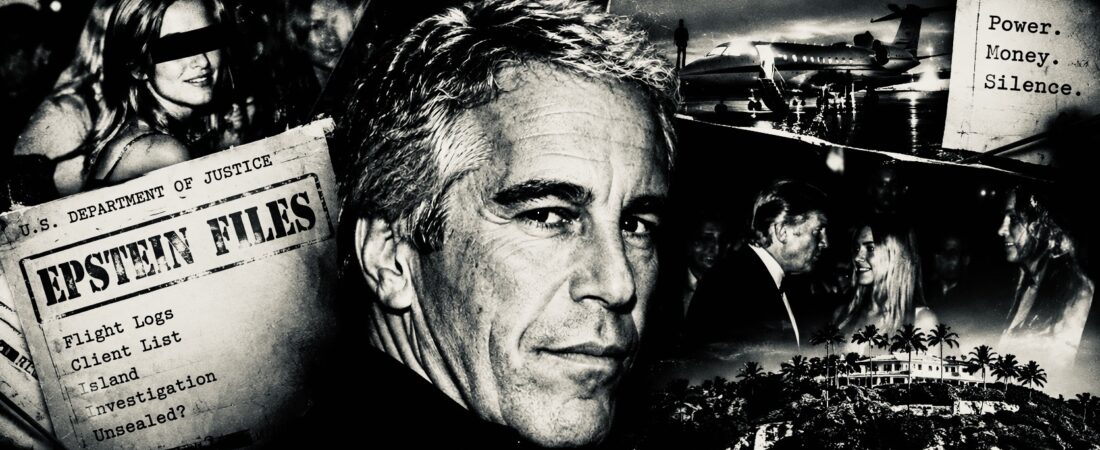
Few hundred years ago, a girl’s readiness to reproduce was determined by the first time she bled. Girls were married at 12, 13, 14. Polygamy, concubinage and the subjugation of women existed openly. Modern laws have changed. Childhood is protected. Consent is recognized. Practices once accepted are now criminal. But what happens to primitive hunger when modern law forces it underground? Has it merely learned to hide?
From Grass-Cutter’s Son to Wall Street’s Favourite Tutor
Jeffrey Epstein was born on January 28, 1953, in New York. His father worked as a grass cutter. As a child, Epstein had an unusual gift for mathematics. He finished school at sixteen and went on to pass the entrance exam for a prestigious college in New York. Money was tight, and he worked part-time to fund his education. He once deposited a counterfeit cheque with the college, which later filed a case against him and soon after, he dropped out.
Around this time, an elite private school, Dalton, in New York — was looking for teachers. Dalton was attended by the children of the country’s top businessmen, politicians and high-society families. Getting a job in Dalton required a degree from a top university, but Epstein got hired without one. Impressed by his mathematical genius, many parents began hiring him privately to tutor their children. Within a few months, multiple young female students complained of inappropriate behaviour by Epstein. One student, Kerry Lawrence, later recalled a ‘mild sense of creepiness’ around Epstein’s interaction with female students. Multiple complaints were filed against him, and in June 1976, the school quietly pressured Epstein into resigning.
Wall Street to The Offshore World
While Epstein worked at the prestigious Dalton School, he was introduced to Alan Greenberg, the former CEO and chairman of the Wall Street investment bank Bear Stearns, through a recommendation from a wealthy parent. At the time, a 23-year-old Epstein was tutoring Greenberg’s son, Ted Greenberg. He also began dating his daughter, Lynne Greenberg, who played a critical role in launching his career in finance at Bear Stearns. According to The New York Times and The Miami Herald, dating the boss’s daughter granted Epstein a “protected status” at Bear Stearns. His stint at the firm ended in 1981 following an internal investigation into a trading and financial violation. He was fined and placed on a two-month suspension. Epstein, instead of waiting out his suspension, chose to resign. While his exit was marred by controversy, spending five years at Bear Stearns cemented his career. He had managed to rise to the level of a limited partner making roughly $200,000 a year. More importantly, he maintained close ties with top Bear Stearns executives — including Alan Greenberg and James Cayne — using his association with the prestigious bank to establish credibility as an independent financial advisor to ultra-wealthy clients.
In the same year, Epstein travelled to England with Paula Heil, another woman he was dating while they both worked at Bear Stearns; where Heil was a junior saleswoman and former Miss Indianapolis. Heil took Epstein to visit a rich acquaintance of hers, Nick Leese, at his family’s countryside manor. At the estate, they met Nick’s father, Douglas Leese, a wealthy British defense contractor with deep connections in the arms industry and the British government. Douglas took an immediate liking to Epstein, eventually hiring him as a consultant for his firm Intercontinental Assets Group, and brought him along to meetings with international elites, introducing him further into high-society circles.
Ghislaine Maxwell: The Fallen Heiress Who Became Epstein’s Right Hand
In the early 1990s, Epstein, while attending a high society party in Manhattan, reportedly met Ghislaine Maxwell, daughter of the British billionaire and media tycoon Robert Maxwell. According to The Times, Maxwell had moved to New York from the United Kingdom following the death of her father under suspicious circumstances in 1991. An alternative timeline provided by Epstein’s former business partner, Steven Hoffenberg, suggests that the pair actually met earlier, around 1988. Hoffenberg claimed that Robert Maxwell himself introduced his daughter to Epstein. Other former staffers have echoed this account, noting that Maxwell described Epstein as someone who could take care of her “emotionally” during the turbulent period of her life. Regardless of the exact introduction date, Maxwell and Epstein were publicly associated with each other by February 1993. They entered an intimate, romantic relationship during the 1990s, during which Maxwell leveraged her high-society connections to bring figures like Bill Clinton and Prince Andrew into Epstein’s orbit.
Epstein and Maxwell began living together at his Palm Beach residence, a 14223-square-foot waterfront estate, in Florida, which Epstein had purchased in 1990. Maxwell immediately established herself as the lady of the house and authored a 58-page “Household Manual” for the staff: They were explicitly commanded to be completely blind and deaf to the household’s activities, and forbidden from answering direct questions. Workers were instructed not to look Jeffrey Epstein in the eye. They could not chew gum, eat, or drink in front of Epstein or Maxwell. Furthermore, items in their pockets could not create a bulge or be visible. Staff were also warned to never disclose Epstein’s or Maxwell’s whereabouts to callers and to report any strange telephone calls or enquiries immediately to Maxwell.
Hidden cameras were installed throughout the house, including the bathroom — inside tissue boxes, clocks, and everyday items. The footage was allegedly collected to act as leverage and blackmail against the powerful politicians, billionaires, and royals who frequented the residence. Jaun Alessi, who served as the estate’s house manager for 12 years (1990-2002), later testified in court for the prosecution during Maxwell’s trial.
The Pyramid Scheme of Abuse
With the house established, Epstein used his massive wealth to buy access to youth institutions. He donated significant sums to schools and institutions. Epstein and Maxwell began visiting art schools, music schools and summer camps, seeking out girls who were emotionally and financially vulnerable, or experiencing family difficulties. Once contact was established, Maxwell utilised a classic sex-trafficker playbook to break down the victim’s defenses. Maxwell would act as a maternal figure or an exciting older mentor. She took the girls shopping, bought them clothes, took them to the movies, and spent time with them by Epstein’s pool. Epstein would invite the girls and their mothers to his mansion for tea, offering to fund the girl’s future education or career goals. The generosity created a trap of financial debt and emotional obligation.
Once girls seemed comfortable, Maxwell began grooming them — bringing them to the house that already displayed nude photographs, sunbathing topless by the pool, organizing games and activities of sexual nature etc. Maxwell framed all this as ordinary adult behaviour and acted as a critical buffer to make the girls feel safe. An adult woman’s presence lowered the minor’s guard, preventing alarm bells from ringing. She gradually desensitised the girls by discussing inappropriate sexual topics, undressing, and massaging Epstein in front of them. Girls were then sorted by how easily they could be controlled, and under the pretext of modelling, photographed nude for a “modelling book” later sent to clients.
As bigger political and business figures began visiting, the girls Maxwell judged reliable were brought to the massage room, where Epstein would already be lying on the table. Maxwell would demonstrate the massage herself, the girl would follow, and Epstein would then sexually assault her — after which the girls were sent to high-value clients. To keep the operation supplied, Epstein and Maxwell turned the victims into recruiters. They offered the young girls hundreds of dollars in cash for bringing in their school friends, classmates, or sisters to the house, expanding the web of abuse exponentially throughout the local school systems.
The First Cracks: Maria and Annie Farmer
The pattern continued for years without interruption. In 1995, Epstein and Maxwell met a student, Maria Farmer, at Academy of Art, New York. They praised her work, brought her paintings and hired her as an artist. Maxwell, under the pretext of an educational program, also brought in Maria’s younger sister Annie. 16-year-old Annie was subjected to abusive topless massage by Maxwell and unwanted sexual advances from Epstein. Around the same time, Maria arrived at a dark, empty office late one evening for a work-related meeting with Epstein. While waiting, a tall man in a business suit — whom she recognised as Donald Trump — entered the room, stood over her in an imposing manner, and stared at her. Epstein eventually emerged, separated the two, and escorted Trump away stating that she wasn’t for him. In another incident, Maria was held against her will in the estate and violently groped and assaulted by Epstein and Maxwell before escaping.
The two sisters eventually discussed what had happened and contacted the New York Police Department and later, the FBI. Despite Maria contacting NYPD and the FBI, federal authorities failed to investigate the allegations, allowing Epstein’s sex trafficking ring to operate for over two more decades. In December 2025, heavily redacted Department of Justice and FBI files were publicly released, officially confirming the existence of Maria Farmer’s September 3, 1996 complaint. The unsealed document revealed the nature of the complaint, the abuse, and death threats. The report explicitly stated that Epstein had threatened to “burn her house down” if Maria told anyone about what had happened. Following the 2025 document release, Annie and Maria expressed a heavy sense of bittersweet vindication, noting the immense emotional toll of seeing proof that the government possessed this information in black-and-white while so many future victims were harmed. Maria Farmer has since filed an administrative claim and a federal lawsuit against the U.S. government for gross negligence regarding its handling of her initial 1996 report.
Trump, Prince Andrew, and a 16-Year-Old’s Nightmare
In the summer of 2000, Epstein and Maxwell attended a party at Donald Trump’s Mar-a-Lago resort in Palm Beach. A 16-year-old Virginia Giuffre worked as a locker room spa attendant in the resort. Maxwell approached the 16-year-old Giuffre, struck up a conversation about massage therapy and recruited her under the guise of training to be a travelling masseuse for Epstein. Giuffre was subsequently groomed by Maxwell in the same manner and eventually brought to Epstein’s massage room and assaulted. She alleged that after being trafficked, she was forced to have sexual encounters with Prince Andrew on three separate occasions when she was a minor.
There were explicit allegations of physical violence, including girls being choked, beaten, and bloodied, alongside sexual assault. The most prominent accounts of physical abuse came directly from Virginia Giuffre’s unsealed memoir and court documents. In her memoir Nobody’s Girl, Giuffre detailed that the abuse she suffered went far beyond sexual exploitation. She wrote about being habitually humiliated, choked, beaten, and left bloodied during her time trapped in Jeffrey Epstein’s trafficking ring. Giuffre stated that the level of physical control and violence used by Epstein and Ghislaine Maxwell was so severe that she genuinely believed she might “die a sex slave”.
Virginia Giuffre later became the primary public accuser of Britain’s Prince Andrew. The encounters occurred at Maxwell’s London townhouse, Epstein’s Manhattan townhouse, and Epstein’s private island in the U.S. Virgin Islands. Giuffre alleged that during the first of three sexual encounters one evening, after they went out to dinner and visited London’s Tramp nightclub, Maxwell explicitly instructed her in the car on the way back to Maxwell’s house: When we get home, you are to do for him what you do for Jeffrey. This evening was also when the infamous, heavily circulated photograph of Prince Andrew with his arm around Giuffre’s waist was taken by Epstein. Prince Andrew consistently denied the allegations of sexual assault. However, in 2022, Giuffre and Prince Andrew reached an out-of-court financial settlement to resolve her high-profile civil lawsuit.
The Island Where The Rules Didn’t Exist
In the mainland U.S., wealthy men who had taken part in Epstein’s arrangements at hotels, mansions, and resorts were getting increasingly worried about being exposed by staff and witnesses. Additionally, complaints and allegations against Epstein and Maxwell in the U.S. were mounting, alongside growing legal and public scrutiny. Around this time, Epstein came across a listing in The Valley Report for a private island for sale — Little St. James, a small island between St. Thomas and St. John in the U.S. Virgin Islands. Epstein bought the 72-acre private island in 1998 for $7.95 million.
After purchasing it, Epstein spent millions of dollars significantly overhauling the property. He carved out new roads, planted 40-foot palm trees, added a helicopter pad, a private dock, a customized bathhouse, a movie theater, and a distinct blue-and-white striped building with a gold dome. Publicly, Epstein presented the island as a high-end, “Zen-like” meditative retreat to entertain global elites, politicians, scientists, and celebrities. Behind the scenes, it was heavily modified and utilized as a highly controlled, secluded compound to traffic, isolate, and sexually abuse young women and underage girls. Victims stated that the remote geography of the island was weaponized as “lock-and-key” isolation so they couldn’t escape or scream for help.
Once the construction was finished, original island workers and staff were let go and Ghislaine Maxwell personally travelled to South Africa to interview and hire new staff, led by a South African couple, Miles and Cathy Alexander, to serve as the on-site island managers. When unsealed court files and civil depositions from survivors were made public, the Alexanders were named. One survivor alleged that the couple was paid very highly to watch everything, shepherded girls around the bungalows, and turned a blind eye to Epstein’s crimes. The victim vividly claimed that after she was raped and fled bleeding and crying, the South African managers comforted her using the same friendly, warm smiles they used to greet guests.
The Pipeline: Eleven-Year-Old, No Questions Asked
A full logistics operation supported the flow of girls to the island. Survivors were frequently recruited from abroad, particularly from Eastern Europe, the Balkans, and Brazil, with false promises of modelling contracts or university scholarships. Epstein’s inner circle systematically manipulated the H-1B (skilled worker) and O-1 (extraordinary ability) visa programs. The physical transit of victims relied entirely on a web of private assets that intentionally bypassed public scrutiny. On one such occasion, Epstein is said to have flown an eleven-year-old girl to the island on his private helicopter without anyone questioning it. Once girls arrived on the island, their passports, phones and identification were confiscated.
Access to the island was granted only through network and personal reference. For the most elite and powerful clients, Epstein didn’t rely on the commercial airport at all — he maintained a customized private jet — The Lolita Express. This was the nickname given to Epstein’s private Boeing 727. Former models and victims described flights on the jet packed with up to 30 young girls at a time, many between the ages of 14 and 16, flying transcontinentally between Paris, New York, and Palm Beach.
According to an extensive analysis of flight manifests and communications between Maxwell and Clinton staffers, Bill Clinton and his entourage travelled on Epstein’s private plane on at least 16 separate flight “legs” between 2002 and 2003. A woman named Lesley Groff, served as Jeffrey Epstein’s executive secretary and personal assistant with her name appearing over 160,000 times across Epstein files. Groff was the central operations manager. She booked the travel for the women, managed Epstein’s strict daily calendar, and scheduled the multiple daily appointments that were explicitly logged as “massages”.
Come to My Mansion, Strip Down, Perform a Massage
Everything had continued largely unchecked until March 2005. The 2005 investigation into Jeffrey Epstein was the first major criminal inquiry into his child trafficking ring. It took place in Palm Beach, Florida, and was led by the Palm Beach Police Department. The investigation began when a mother and stepfather approached the Palm Beach police. They reported that a wealthy man named Jeff had paid their 14-year-old stepdaughter to come to his waterfront mansion, strip down, and perform a massage, which resulted in sexual molestation. As detectives began digging, they quickly realized the abuse was systematic. Over the course of a year, the police ultimately identified and interviewed at least 36 underage girls (between the ages of 14 and 17). They all recounted near-identical stories of being paid hundreds of dollars for “massages” that escalated to sexual abuse.
Police raided Epstein’s Palm Beach mansion and found extensive physical evidence, nude photographs, sex toys, including security footage and flight logs, backing up the girls’ accounts. The police department believed they had a bulletproof case that would put Epstein in prison for the rest of his life. However, Palm Beach state attorney, Barry Krischer took the unusual step of taking the case to a grand jury rather than charging Epstein directly. Prosecutors presented only a fraction of the police evidence, allegedly minimising the victims’ accounts and portraying them as willing prostitutes. The grand jury returned a minor state charge of solicitation. The FBI launched a parallel federal investigation called “Operation Leap Year,” and federal prosecutors drafted a massive 60-count indictment against Epstein for sex trafficking. Epstein’s high-priced legal team secretly negotiated a controversial deal with the U.S. Attorney in Miami. Under this widely criticised “sweetheart deal”, the federal government agreed to completely drop the 60 federal charges and grant blanket immunity to Epstein.
Because of the investigation’s derailed ending, Epstein effectively evaded justice. He pleaded guilty to two minor state prostitution charges in 2008 and was sentenced to 18 months in jail.
Eighteen Months, Private Suite, Model Prisoner
Epstein’s time in custody bore little resemblance to a standard sentence. Authorities granted him unprecedented privileges, which he systematically used to mock prison rules, maintain his lavish lifestyle, and continue exploiting young women. Epstein was granted a highly unusual work-release program that allowed him to leave jail for up to 12 to 16 hours a day, six days a week. While out on work release, Epstein had dozens of young women—some over 18 but looking like teenagers—visit his office. Survivors’ attorneys and internal affairs investigations later revealed that Epstein engaged in improper sexual contact and ongoing exploitation inside that office while he was supposed to be serving his sentence. The Palm Beach deputies assigned to guard and monitor Epstein while he was out of jail were heavily criticised. Reports indicated that deputies often sat outside the office or looked the other way while young women filed in and out of his private suite.
The leniency of his incarceration extended beyond the office walls: Despite explicit restrictions banning him from going home, Epstein’s drivers frequently bypassed the office and drove him directly to his multi-million dollar Palm Beach waterfront mansion. He spent hours at his estate during his “jail” days. While sleeping at the jail, Epstein was kept completely separate from the general inmate population in a private, minimum-security wing. He was treated with immense deference by jail staff, with one deputy later describing him as a “model prisoner” simply because he had the money and power to ensure everyone accommodated his needs.
2019: No Cellmate, No Foul Play?
In November 2018, journalist Julie K. Brown, after investigating multiple victims and building her own reporting, published — Perversion of Justice — an account concluding that the U.S. court system and the FBI had effectively let Epstein off despite what he had done to children. The report set off nationwide outrage. Soon after, Republicans and Democrats in Congress began a joint investigation into how the Department of Justice had handled the original case. Victims began speaking openly, describing the massages, cash payments, and recruitment network in detail.
On July 6, 2019, federal agents arrested Jeffrey Epstein at Teterboro Airport in New Jersey after he flew in from Paris on his private jet. The U.S. Attorney’s Office for the Southern District of New York indicted Epstein on federal charges of sex trafficking of minors and conspiracy to engage in sex trafficking. On July 18, 2019, a federal judge denied Epstein bail, labelling him an extreme flight risk and a clear danger to the community. He was remanded to the Metropolitan Correctional Center in Lower Manhattan to await trial. His house, island, and other properties were raided, and police recovered CDs, nude photographs, and a fake Australian passport bearing Epstein’s photo and a different name. Investigators also found unusual items in the house, including contraceptives packaged with images of Donald Trump on them and a painting depicting Bill Clinton in women’s clothing.
Days after being denied bail, an incident occurred in Epstein’s cell that foreshadowed his death. Epstein was found semi-conscious on the floor of his cell with injuries to his neck. At the time, Epstein was sharing a cell with Nicholas Tartaglione, a former police officer facing quadruple homicide charges. Epstein reportedly claimed to his lawyers and prison staff that Tartaglione had assaulted and choked him. Tartaglione strongly denied this, claiming he actually saved Epstein’s life after Epstein tried to hang himself. Following the incident, prison officials placed Epstein on suicide watch, meaning he was housed in a cell with no sheets, wore a tear-resistant smock, and was under 24/7 observation by psychological staff. On July 29, 2019, psychological staff cleared Epstein and removed him from suicide watch. He was placed in the jail’s Special Housing Unit under standard “close observation”. However, a series of catastrophic operational failures immediately followed.
The jail protocol required Epstein to have a cellmate at all times to deter self-harm. His cellmate was transferred out on August 9, and no replacement was assigned, leaving Epstein entirely alone. The two guards assigned to watch his unit, Tova Noel and Michael Thomas, were working extreme overtime shifts. Instead of performing their mandatory checks on Epstein every 30 minutes, the guards surfed internet and fell asleep for eight hours. They later falsified prison logs to hide the fact that they had skipped their rounds. On the morning of August 10, 2019, guards discovered Epstein hanging in his cell. Subsequent investigations by the Department of Justice Office of the Inspector General concluded that while the Bureau of Prisons committed negligence, misconduct, and outright job performance failures, there was no evidence of a criminal conspiracy or foul play in his death.
Since Epstein died before facing trial, the criminal charges against him were dismissed, though federal prosecutors shifted focus to convicting his chief co-conspirator, Ghislaine Maxwell, in 2021.
Mossad Angle: Israel, FBI and a File Number Nobody Can Verify
The scrutiny over Epstein’s potential espionage ties exploded into mainstream relevance following a series of massive Justice Department and FBI document dumps. A heavily scrutinised 2020 FBI report details statements from a Confidential Human Source who claimed to have listened to phone calls between Epstein and his attorney, Alan Dershowitz. The informant stated they “became convinced” Epstein was trained as a spy and relayed intelligence to Mossad through intermediaries. According to the same FBI memo, the informant alleged that Dershowitz explicitly told U.S. Attorney Alex Acosta during the controversial 2008 Florida plea negotiations that Epstein belonged to both U.S. and allied intelligence services, including Mossad. The files detail Epstein’s extensive, long-running financial and social ties to prominent Israeli politicians, most notably former Israeli Prime Minister Ehud Barak. Declassified documents show Epstein also funded organizations heavily tied to the Israeli military and state-backed initiatives.
Despite the intense circumstantial evidence and the claims embedded within the FBI informant files, no direct, on-the-record confirmation of Epstein being a spy exists from any intelligence agency. High-ranking Israeli politicians, including Prime Minister Benjamin Netanyahu and former Prime Minister Naftali Bennett, have categorically and aggressively rejected the claims. Bennett officially labelled the allegations that Epstein was running an Israeli blackmail ring as a “vicious wave of slander and lies”.
The Release of the “Epstein Files”
Epstein’s death did not end public pressure — it intensified demands that all the documents, photographs, and evidence gathered during the investigation be made public. The release of the Epstein files—which culminated in a massive Justice Department drop of over 3 million pages, videos, and images following the passage of the Epstein Files Transparency Act by Congress on November 19, 2025 — has exposed the extensive reach of Jeffrey Epstein’s social and financial network.
The documents reveal the following information regarding the most popular names mentioned:
Donald Trump
Donald Trump’s name appears hundreds of times throughout the database.
- The Context: The files contain historical logs from the 1990s detailing Trump flying on Epstein’s private plane, as well as accounts of Epstein visiting Mar-a-Lago. One lawsuit document from a victim described a moment in the 1990s where Epstein allegedly introduced her to Trump at Mar-a-Lago, nudging Trump and joking, this is a good one, right?
- The Allegations: The tranches included an FBI-compiled summary of tips sent to the National Threat Operations Center, including an unverified 2019 allegation from a woman claiming sexual misconduct.
- Response: Trump has aggressively denied any wrongdoing, stating that his friendship with Epstein ended long before Epstein’s 2008 conviction.
Bill Gates
The files contain hundreds of references to Microsoft co-founder Bill Gates, mapping out a much more extensive electronic paper trail than previously known.
- The Extramarital Claims: The most explosive element involves draft emails that Epstein wrote to himself in July 2013. In these unedited notes, Epstein claimed he facilitated sexual encounters for Gates and alleged that Gates had contracted a sexually transmitted infection from Russian women.
- The Blackmail Context: The documents line up with prior reporting that Epstein attempted to leverage his knowledge of Gates’s extramarital affairs to pressure him financially.
- Response: Gates has strongly rejected the claims, admitting that while it was a “huge mistake” and “foolish” to meet with Epstein for philanthropic discussions, he had absolutely no knowledge of Epstein’s criminal behaviour.
Stephen Hawking
Renowned theoretical physicist Stephen Hawking heavily trended online after his name and a specific photograph appeared in the unsealed tranches.
- The 2006 Physics Conference: In March 2006, Stephen Hawking and roughly 20 other elite global physicists visited the U.S. Virgin Islands for a scientific conference funded by Jeffrey Epstein.
- The Island Visit & Submarine Tour: During the conference, the scientists were hosted for an offshore barbecue on Little St. James, where Epstein paid for a private submarine to be structurally modified so Hawking could go underwater for the first time in his life.
- The 2015 “Orgy” Email: An email sent by Epstein to Ghislaine Maxwell in January 2015 revealed Epstein panicking over rumours and attempting to offer bounty money to anyone who could debunk Virginia Giuffre’s claims that Hawking had participated in an underage orgy.
- No Accusations of Misconduct: No victim testimony or formal legal charge has accused Hawking of sexual misconduct, and legal analysts noted that Epstein’s email was an attempt to disprove the rumours, not confirm them.
- The Bikini Photo Debunked: A viral, redacted photo in the files showing Hawking between two women in bikinis was proven to be entirely unrelated to Epstein; it was taken at a Ritz-Carlton in Orlando, Florida, and the two women were Hawking’s professional medical caregivers.
Twenty Women, One Ranch: Epstein’s Most Disturbing Obsession Yet
The files also reflect Epstein’s interest in transhumanism, which he pursued by cultivating relationships with academics, researchers, and scientists, discussing his ideas with them at his gatherings. Jeffrey Epstein’s fixation on transhumanism and his disturbing “baby ranch” plan represent one of the most chilling chapters of his network, which was extensively detailed by The New York Times and later backed up by the unsealed Justice Department documents.
His ambitions went far beyond standard philanthropy, crossing into modern-day eugenics, population control, and genetic determinism.
Epstein owned the Zorro Ranch, a sprawling 10,000-acre estate outside Santa Fe, New Mexico. Beginning in the early 2000s, he routinely confided to prominent scientists, academics, and business associates about a systematic plan to “seed the human race” with his own DNA.
- The Logistics: Epstein’s explicit plan was to have 20 women impregnated at a time with his sperm at the New Mexico property. The compound was meant to house these women while they gave birth to his children, effectively acting as a clinic to propagate his genetic material.
- Screening Candidates: Virtual reality pioneer Jaron Lanier reported that Epstein used his high-society dinner parties—where many guests were attractive women with exceptional academic credentials—to quietly screen candidates he deemed worthy of bearing his children.
- Victim Account: Survivor Johanna Sjoberg testified in court depositions that during a visit to Zorro Ranch in 2005, Epstein directly asked her to be the mother of his child, an offer she immediately rejected.
Epstein’s plans were rooted in his extreme fixation on transhumanism—the belief that the human species can be physically and intellectually enhanced through technology, artificial intelligence, and genetic engineering. Critics, scientists, and historians have pointed out that his interpretation was a modern revival of eugenics, the widely discredited practice of controlled human breeding.
- DNA Obsession: The unsealed files show that Epstein was hyper-focused on genetic dominance. He spent thousands of dollars on advanced, high-end DNA sequencing for himself.
- Distributing DNA Kits: His assistants revealed that Epstein treated genetic testing kits (such as 23andMe) like business cards, constantly handing them out to guests and acquaintances to map their traits. He routinely emailed scientists asking if random human behaviours and personality traits were genetically inherited.
- Cryonics: Epstein also planned for his own biological preservation. He discussed funding cryonics (the science of freezing bodies for future resurrection) and told associates that he wanted his head and his penis frozen after his death so he could be brought back to life.
Epstein successfully used his immense wealth to buy access to some of the world’s most brilliant minds, using them as a sounding board for his bizarre theories.
- The Network: He funded and hosted elite scientists, including molecular engineer George Church, evolutionary biologist Stephen Jay Gould, and cognitive scientist Noam Chomsky.
- The Dynamic: According to attendees, Epstein would guide dinner conversations toward “race science”, eugenics, and genetic modification. While many scientists contested his ideas or treated them as mere eccentric conversation, others implicitly tolerated the discourse because Epstein was actively funding their university labs and research projects.
While investigators concluded there is no concrete evidence that the “baby ranch” scheme ever successfully progressed past a dark fantasy, the unsealed FBI files renewed intense legal scrutiny over the property. New Mexico state lawmakers launched an official Truth Commission and authorised state prosecutors to conduct new physical searches of Zorro Ranch to fully uncover the extent of the trafficking and abuse that took place there.